Ready-Made Templates
 GDPR Compliant
 38,000+ Users




 Easy to Use
 No Technical Configuration
 Fully No-Code
Step-by-Step Guide
Step 1: Sign Up & Upload Your Data
First, Sign up for Datablist.com
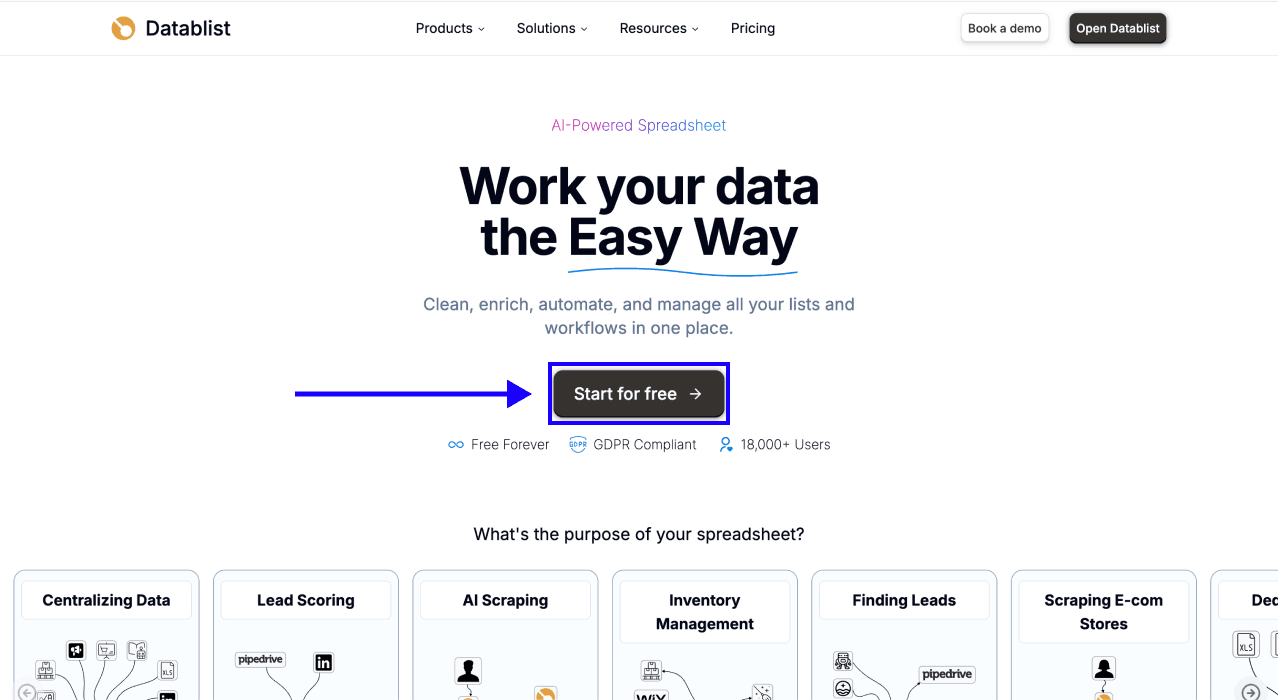
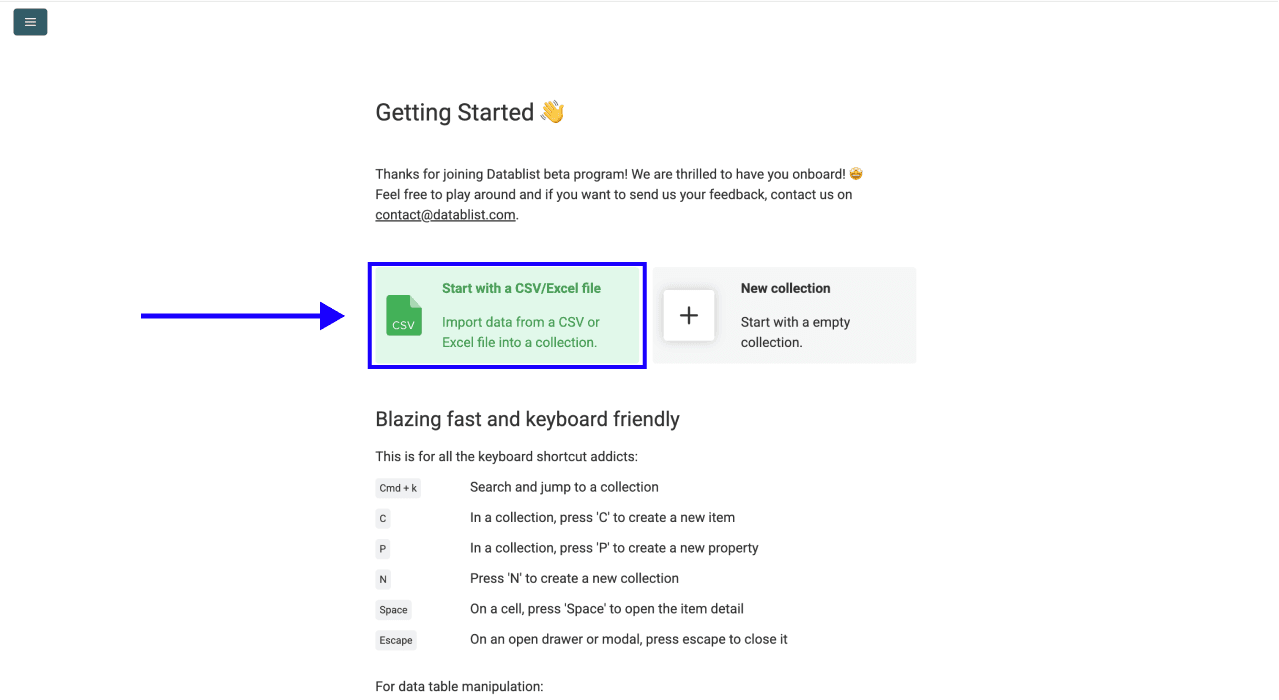
Then, Upload your CSV or Excel file containing your company names and website URLs
Give the agent whatever context you have. It makes a real difference to the results.
The AI Agent runs one research task per selected row. Start with company names and websites, or any columns that provide context for your research. Import a CSV or Excel file, keep your original columns, and add the researched fields alongside them.
Step 2: Navigate to the Enrichment
-
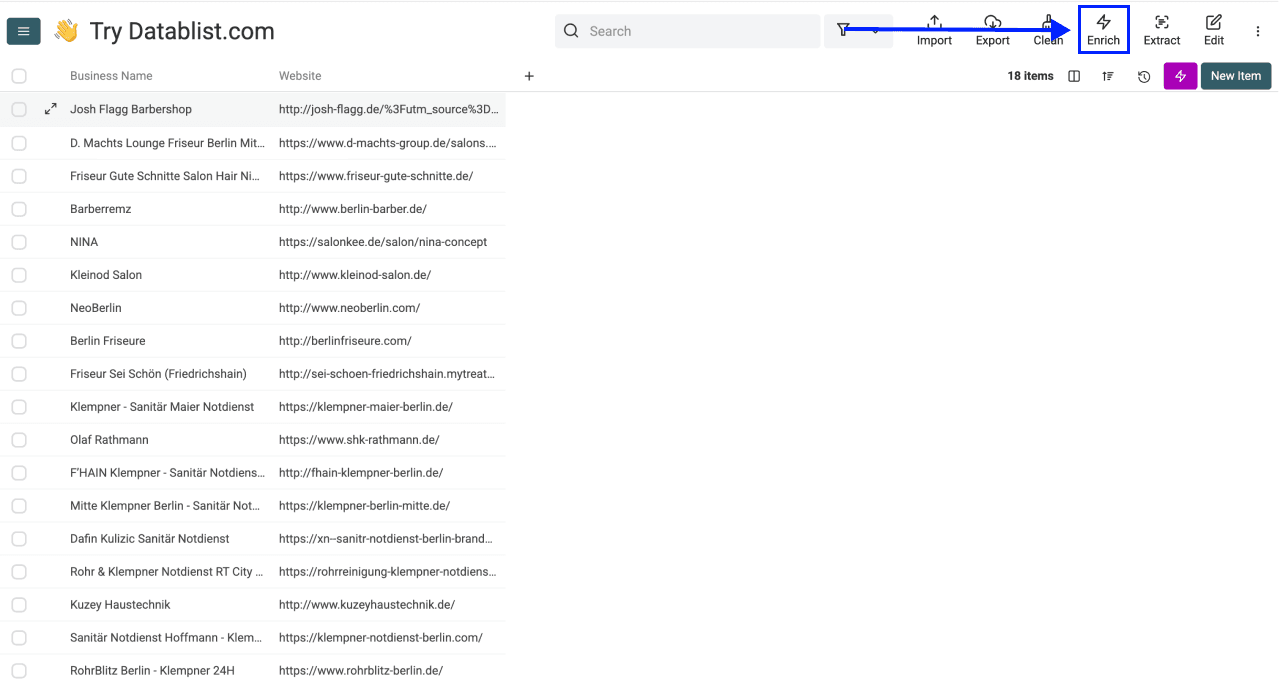
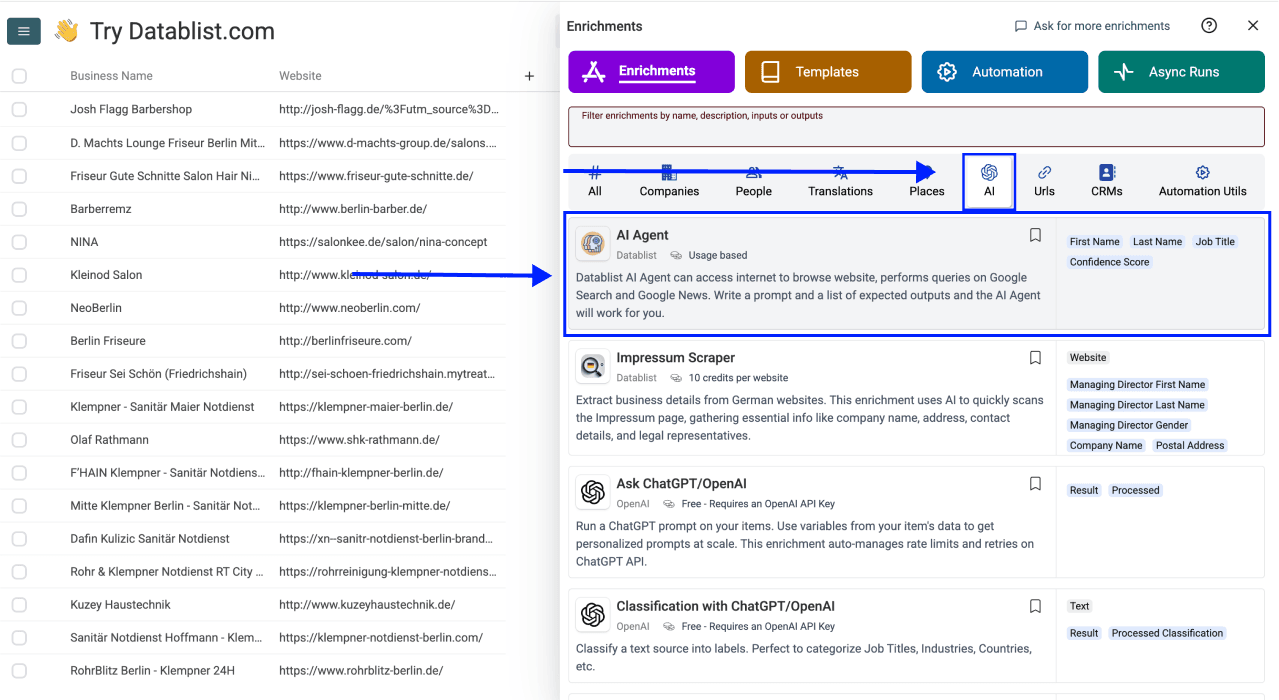
Click on Enrich in the top menu
-
Go to the AI tab
-
Select AI Agent
Step 3: Select a Template, or Write Your Own Prompt
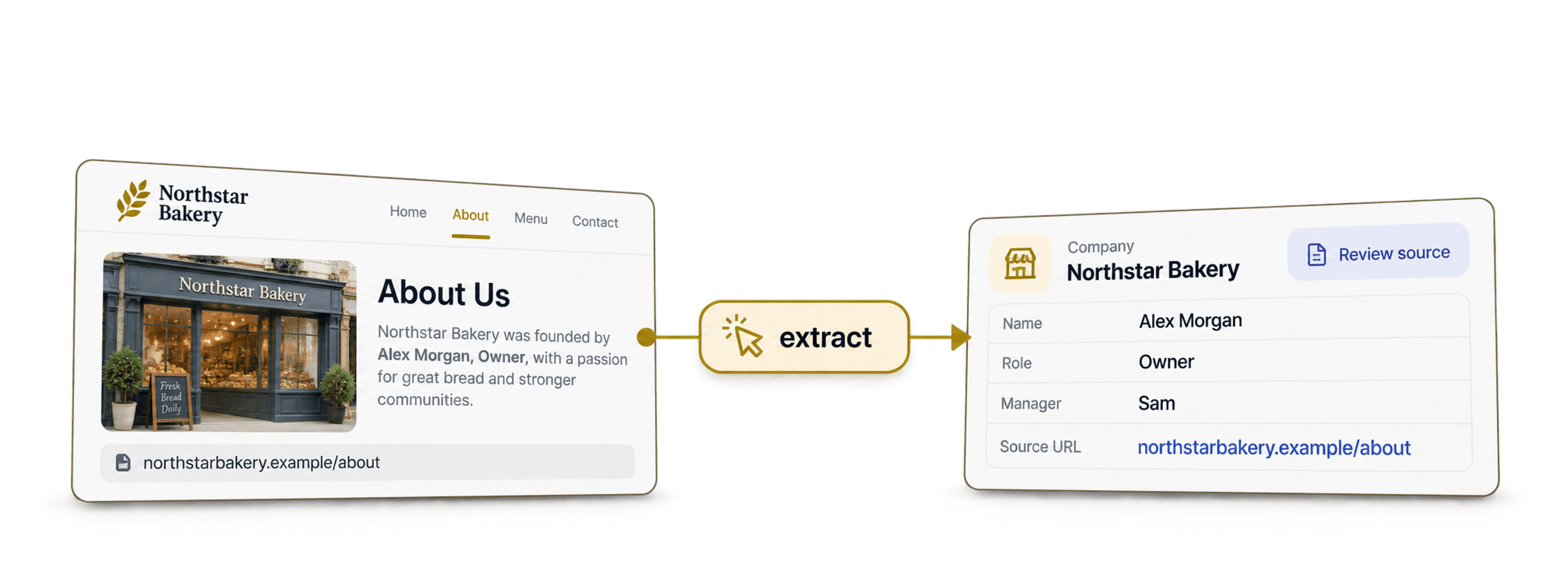
Click on the Template Drop-Down and select a ready-made template, for example "Business Owner Finder".
You don't have to write a single prompt. The template is ready to use out of the box. Just select it, put your variable in, and Datablist handles the rest. If you ever want to customize what the AI looks for, you can edit the template in plain English.
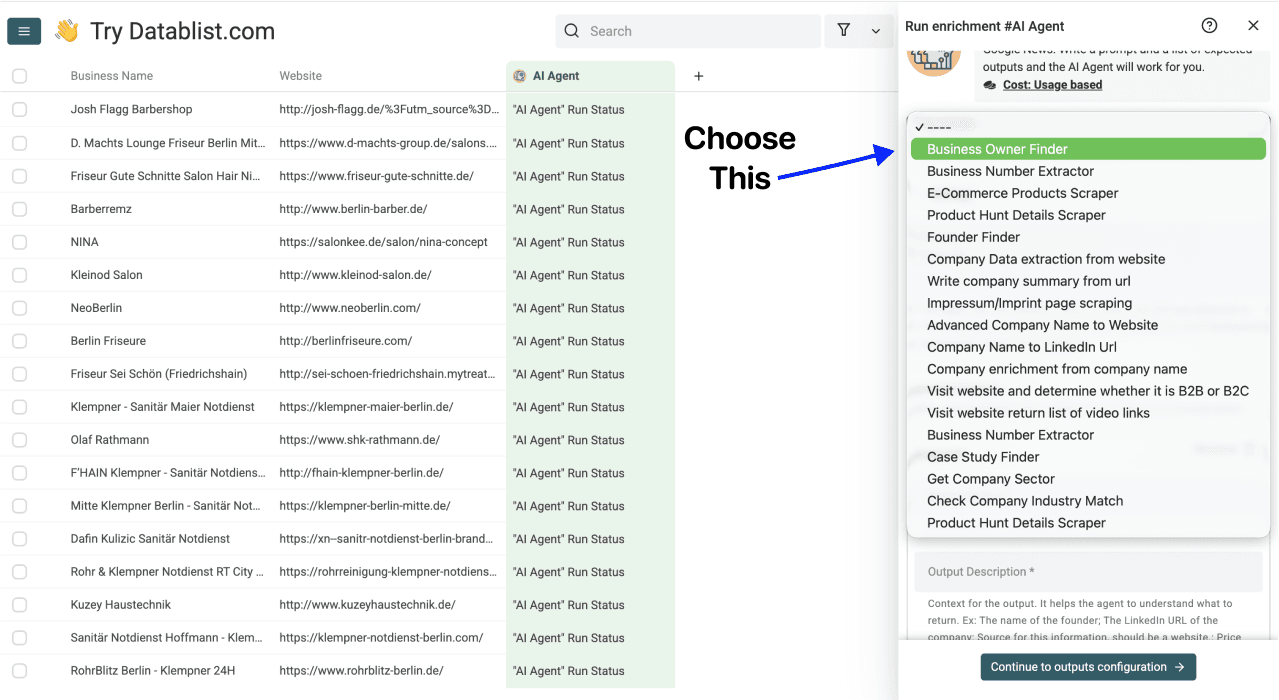
To write your own instead, keep it concrete and pull your columns in by typing / and selecting the property:
-
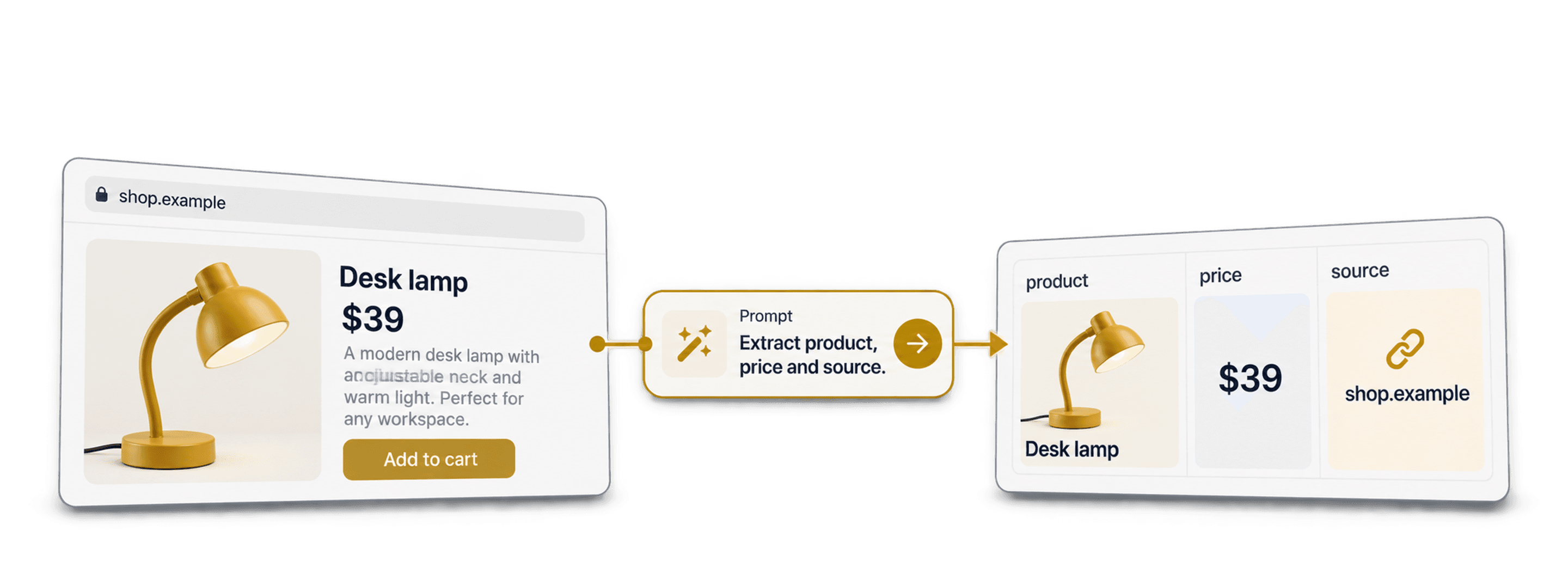
Visit /Website and find the name and title of the Head of Marketing
-
Analyze /Website. Does this company sell to businesses or consumers?
-
Find the Impressum page on /Website and extract the Managing Director's name
For a custom task, clearly define what you want for each row and follow the best practices for writing prompts. Set the output names, descriptions and types to match the task. A source URL can be one of your expected outputs when you need to verify the answer.
Step 4: Map Your Input Property
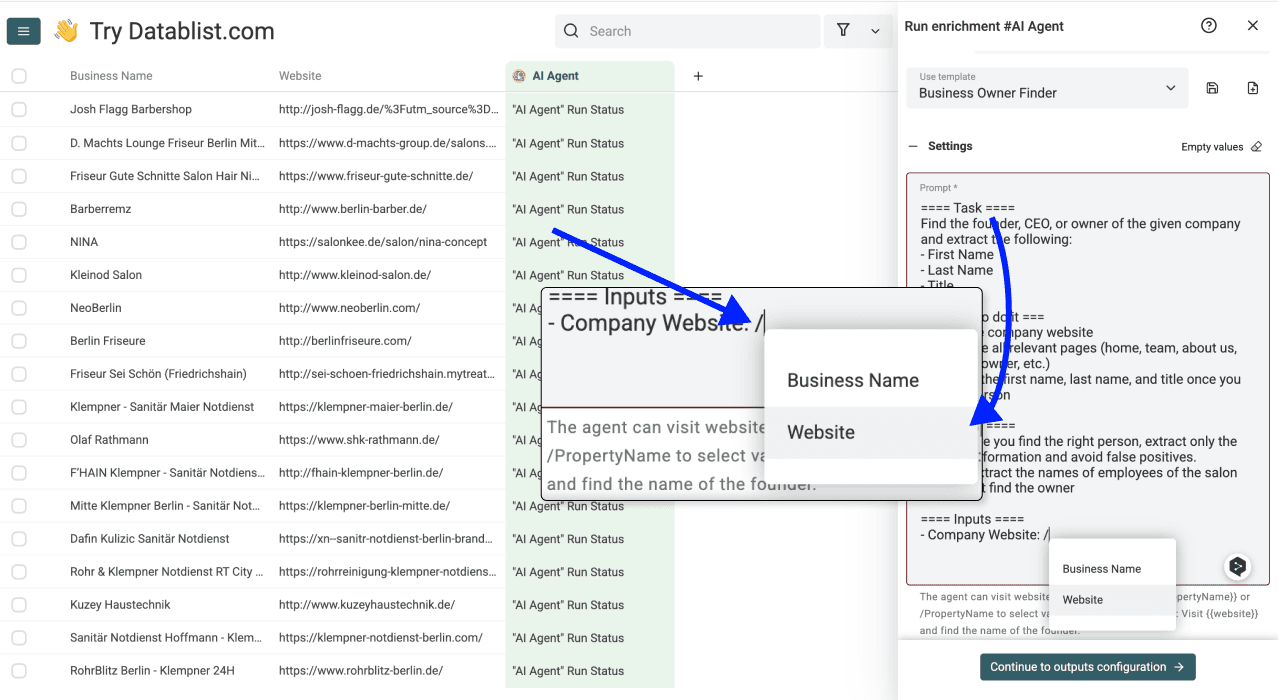
Scroll down and insert the website URL as your Input Property. You can do this by typing / and selecting the column that contains your website URLs.
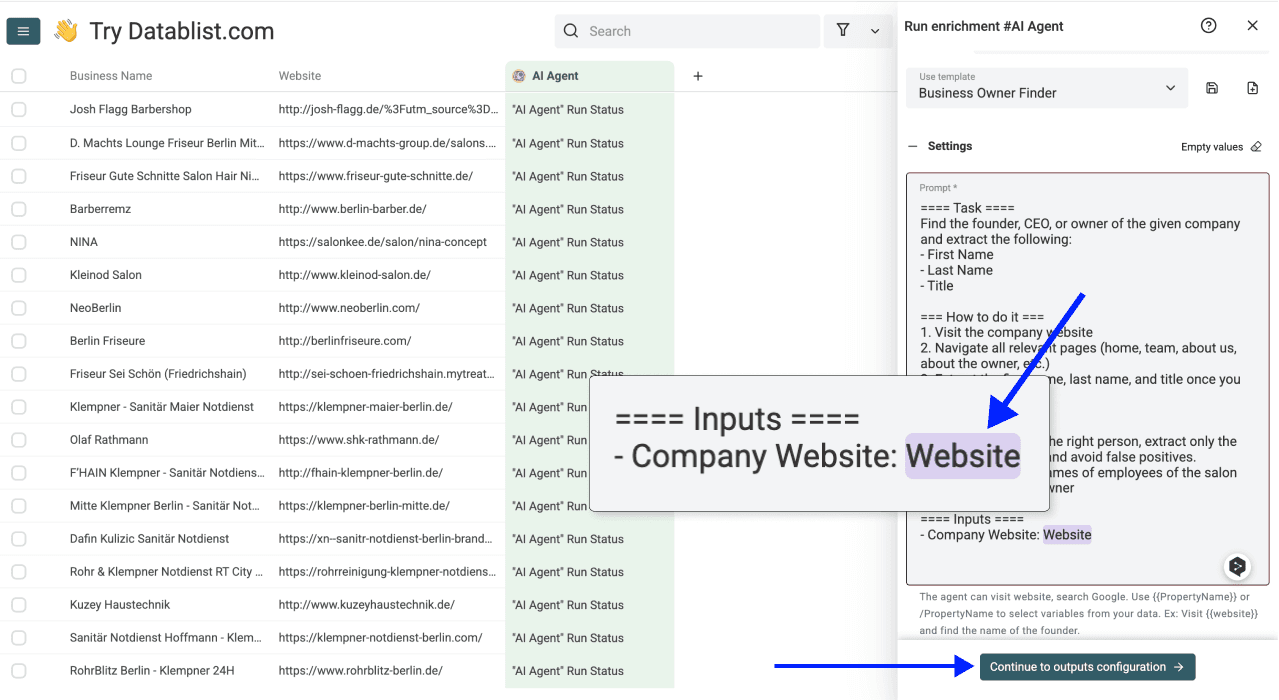
Once the variable appears in purple, click on Continue to outputs configuration
Step 5: Select Outputs
Name every field you want back, one per output. The Business Owner Finder template, for example, returns:
-
First Name: The business owner's first name
-
Last Name: The business owner's last name
-
Job Title: Their role at the company
Keep your outputs narrow. A field like Owner Name is far more reliable than a field like Details, and an output the prompt never asks for comes back empty.
Add Confidence Score too, and review the run-status column to triage a large run afterwards. Click the icons to add them to your collection, then click Instant Run
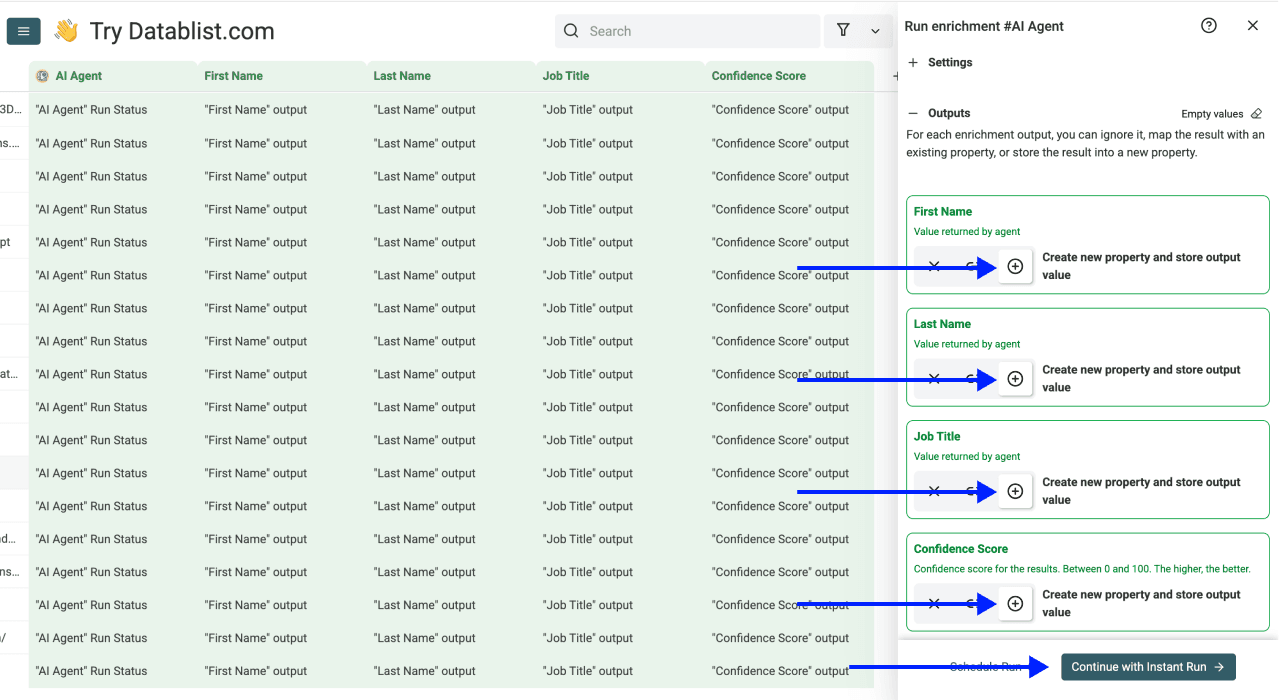
Each expected output has a name, a description and a type: Text, Long Text, URL, Number, DateTime or Checkbox. Confidence Score is optional and ranges from 0 to 100. It is a model assessment, so spot-check results against the source rather than treating the score as proof.
Step 6: Run the Enrichment
Open Advanced Settings before a large run. Max iterations caps how many steps the agent may take on a single row, which is your main control over cost. The default of 7 suits most tasks. If your target sites render through JavaScript, enable Render HTML, which adds 2 credits per scrape.
Configure your run settings by clicking on the chevron on the right side of the button:
-
Run on first 10 items: Good for checking results before committing
-
Run on first 100 items: Useful for validating larger samples
-
Run on first {X} items: Choose exactly how many to process
-
Run on all view items: Process your entire list (or view if you've enabled filters)
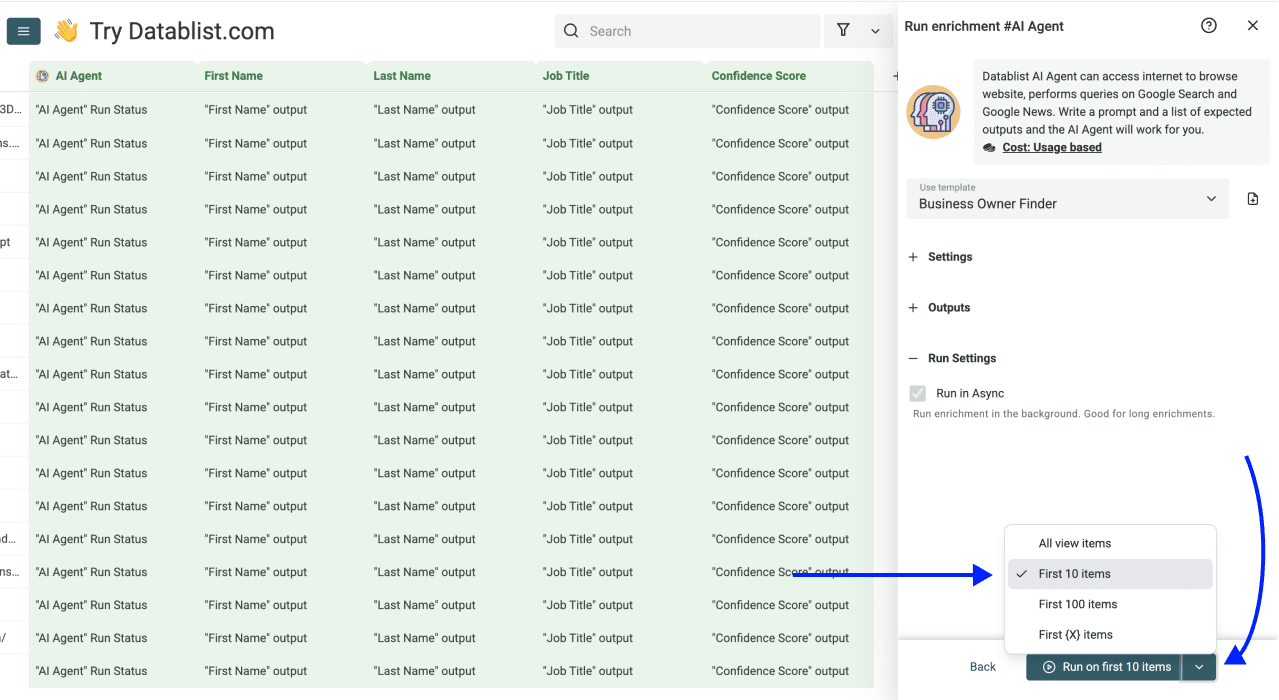
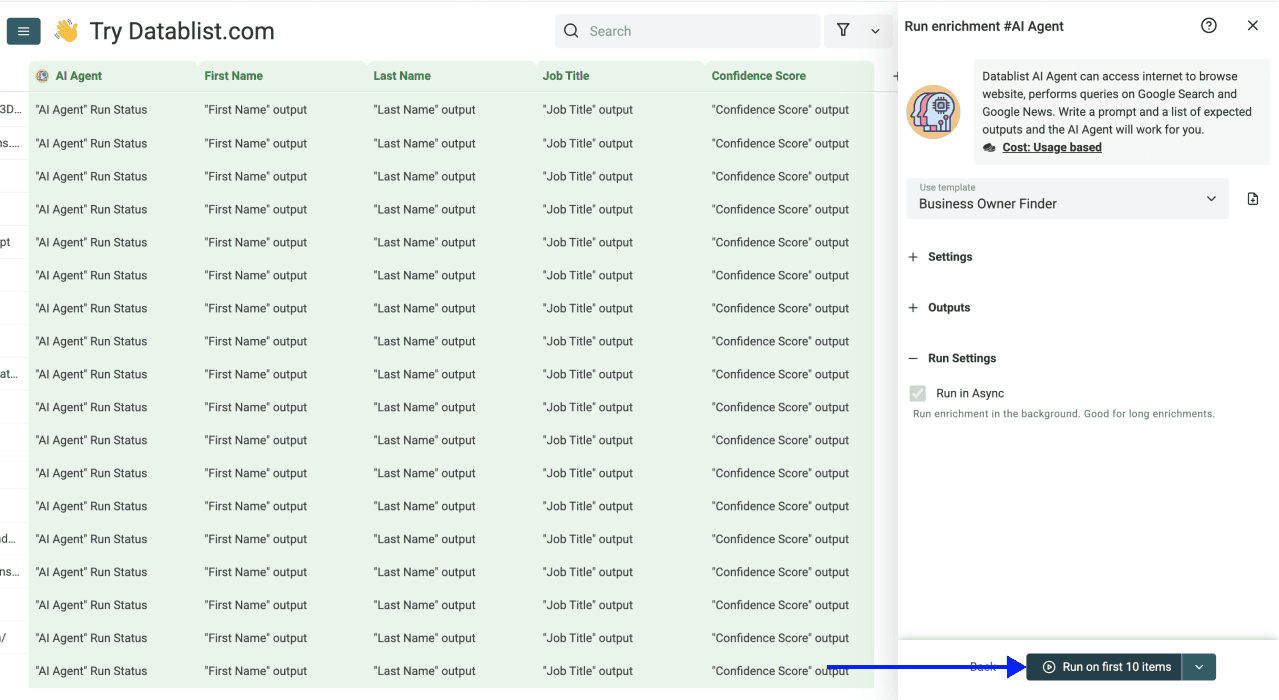
Once you have chosen your preferred option, click Run on X items
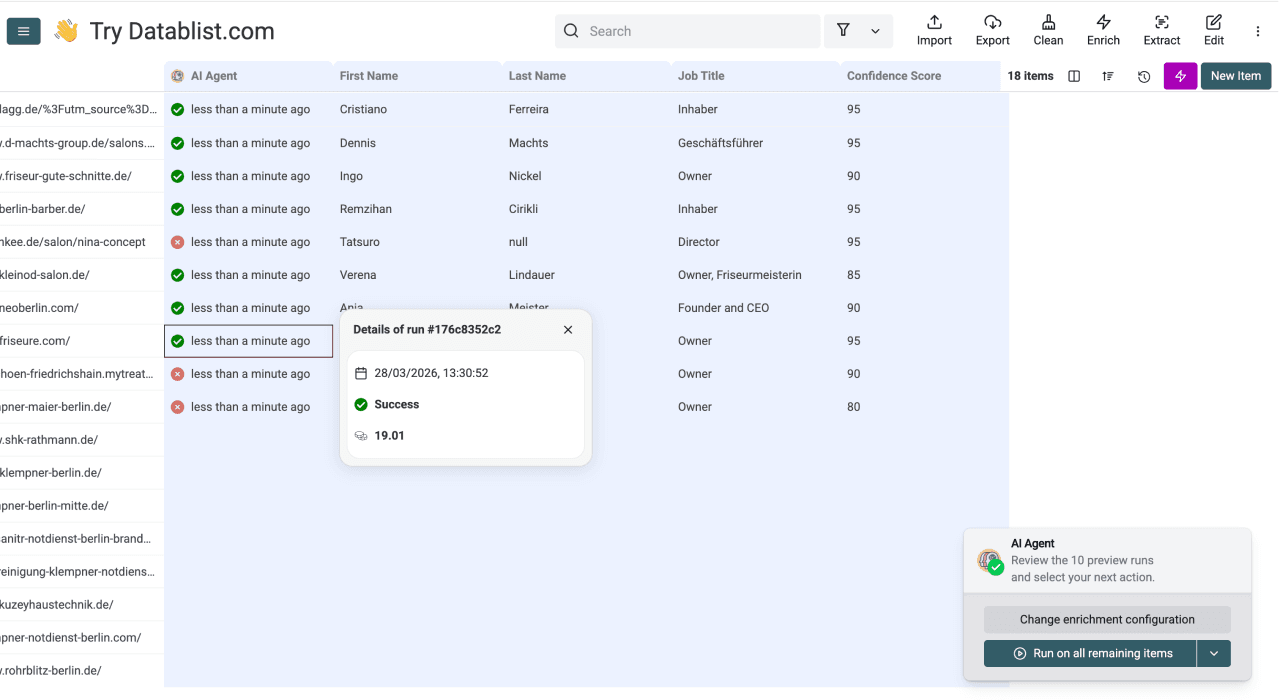
When the run finishes, the fields you asked for are populated in your collection. Read your real per-row credit cost off that first sample before scaling up.
Advanced Settings also lets you select the model. GPT 4o-mini is the default. Max iterations defaults to 7; the current action accepts values up to 20. The setting limits research depth, rather than imposing a fixed credit cap.
Review the new columns and run status, fix the prompt or inputs where needed, and rerun only the rows that need attention. You can filter and export the enriched collection.
Research Examples
Adapt these examples to your columns, then configure an output for each field you want back. You can research public websites that do not provide an API.
Lead Generation
- Deep Company Research: Find information not available in standard databases. Ask the agent to visit a prospect's website and find:
- Specific technologies mentioned on their site.
- Details about their key services or products.
- Recent company news or blog post topics.
- Information from their "About Us" or "Team" pages.
- This adds invaluable context for personalized outreach. (See: Advanced Website Finding)
- Targeted Contact Identification: Instead of just scraping names, ask the agent: "Visit the team page on
{{Website}}and find the name and title of the Head of Marketing." - Intelligent Lead Qualification: Use the agent to check if a prospect fits your Ideal Customer Profile (ICP). Prompt: "Analyze
{{Website}}. Does this company primarily serve B2B or B2C clients? Does their blog mention challenges related to data management?" - Case Study & Client Extraction: Find social proof for personalization. Prompt: "Search
{{Website}}for case studies or client logos. List the names of any clients mentioned." (See: Scrape Case Studies) - Specific Data Point Scraping: Extract information from pages without clear structure, like finding contact details on German Impressum pages. Prompt: "Find the Impressum page on
{{Website}}and extract the Managing Director's name and email."
Website Data Enrichment
- Website Summarization: Get the gist of a website quickly. Prompt: "Visit
{{Website}}and provide a one-paragraph summary of what this company does." - Contextual Information Extraction: Pull specific facts or figures. Prompt: "Visit the pricing page on
{{Website}}and extract the starting price for their 'Pro' plan." - Technology Stack Identification: Discover what tools a company uses. Prompt: "Analyze the website content and job postings on
{{Website}}to identify marketing automation or CRM tools they might be using."
Market & Competitor Research
- Competitor Product/Service Monitoring: Prompt: "Visit the product page for
{{Competitor Product URL}}. What new features have been announced recently?" (See: Automating Research) - Sentiment Analysis from Forums/Reviews: Prompt: "Search Reddit for recent discussions about
{{Product Name}}. Summarize the general sentiment." - Industry Trend Identification: Prompt: "Analyze the blogs of these five industry websites:
{{URL1}},{{URL2}}, ... What common themes or topics emerged in the last month?"
Other Research Tasks
- Content Research: Find statistics, research topics and compare competitor content.
- Data Cleaning: Verify company details against their live website.
Prompting Your AI Agent for Success
The quality of your results heavily depends on the quality of your prompt. Borrowing from our guide on writing effective AI prompts:
- Be Specific: Don't just say "Find info." Say "Find the name of the CEO listed on the About Us or Team page of
{{Website}}." - Define the Role: Start with the agent's task, e.g., "You are a research assistant. Your task is to visit
{{Website}}..." - Provide Context: If looking for specific types of companies, describe them. "Search for case studies related to the software industry."
- Specify the Output: Clearly define what you expect back. "Return only the CEO's name. If not found, return 'Not Found'." Use the output configuration fields.
- Break Down Complex Tasks: If a task involves many steps, consider breaking it into multiple prompts or agent runs.
- Iterate: Your first prompt might not be perfect. Review the results and refine the prompt for better accuracy.
Costs and Limitations
The AI Research Agent uses credits for model tokens and research tools. It can use credits even when it finds no usable answer. The page calculator sizes a plan using the upper end of an approximate 3–25-credit range per row at the default model and 7 iterations. This is guidance, not a quote or a guaranteed maximum.
Render HTML costs 2 credits per scrape. The calculator assumes one rendered scrape per row; additional pages can increase actual usage. Different models and more iterations can also change the cost. Test 10 or 100 rows, inspect actual usage, and then scale up. See Datablist credits and pricing for current plan and package prices.
The agent works on the public web. Login pages, paywalls, CAPTCHAs and unavailable data can prevent results; JavaScript-rendered sites may need Render HTML. More complex tasks take longer than direct API lookups. The agent uses Datablist-managed model keys; it currently has no setting for your own model API key.